Whimsy in Adversity

Sometimes there are stories in newspapers of armchair archaeologists who spot hidden earthworks on Google Maps. They zoom in and see the outlines of long buried Viking longhouses or Saxon burial mounds or ditched flying saucers, and they head out with spades and buckets to dig them up.

Years later, the sparkly Saxon results of these digging sessions turn up in glass cases in the British Museum, while the spaceships are quietly hidden away, if they don’t take off moments after discovery and fly home with dirt and clumps of grass tumbling from their wings as they gain altitude.

I’ve never been an online archaeologist. My peregrinations through the towns and villages of Google Maps before holidays offer the perfect antidote to working for a living, but I’ve never found anything strange. Until recently, when I spotted the outline of a balloon cut out of grass in the middle of an industrial estate in my hometown of Oldham.

I briefly wondered if I’d discovered the compressed remains of a lost zeppelin, one of Stanley Spencer’s prototypes perhaps, the man who flew a rudimentary airship from Crystal Palace into central London in 1902, while throwing little muti-coloured rubber balls down from his basket high above the city to demonstrate what some nefarious force could do with bombs, if world affairs ever developed in that direction.
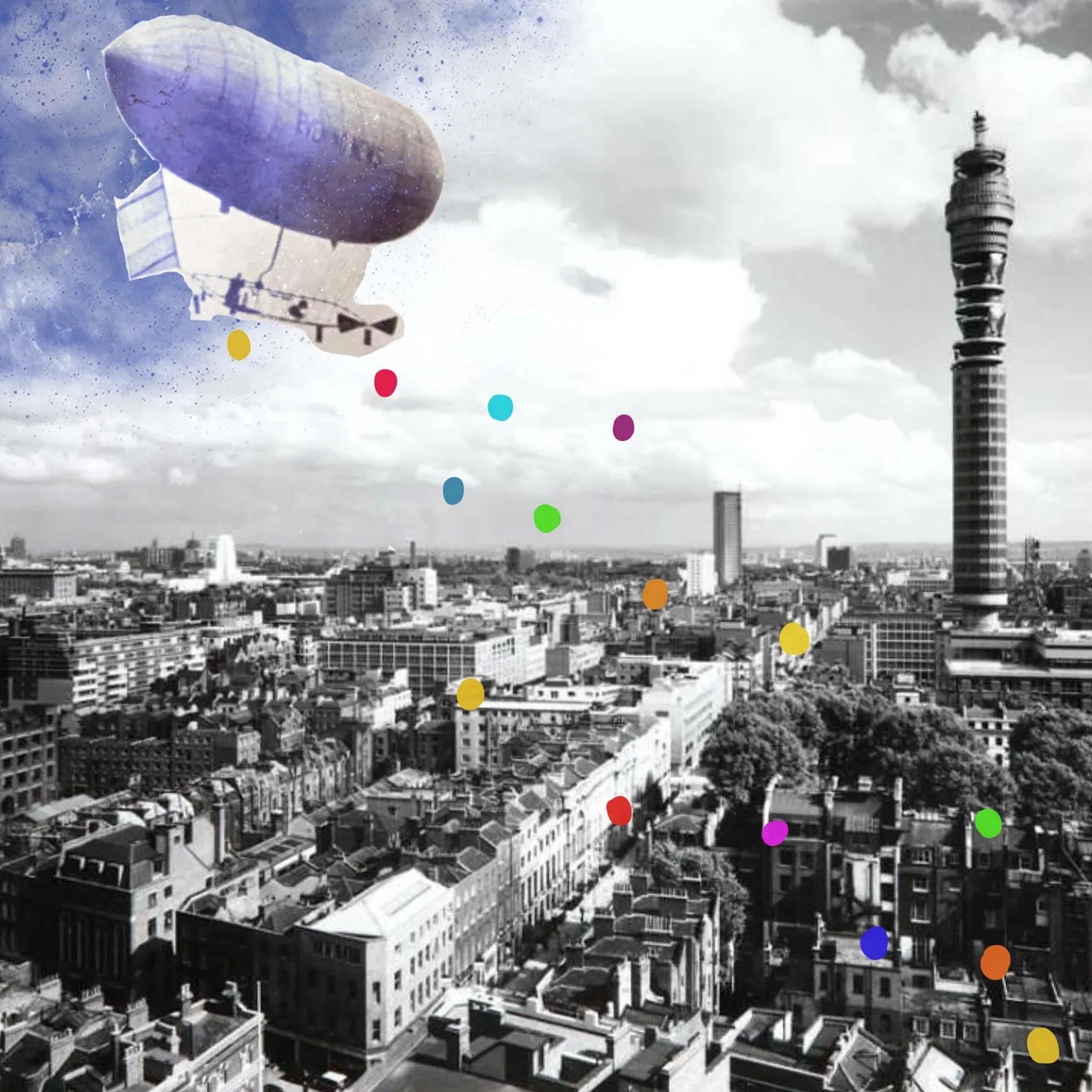
That was not what I had found though. The little grass airship was in fact a memorial to the Bowlee Barrage Balloon Centre, the Second World War-era headquarters of the 925, 926 and 931 Balloon Barrage Squadrons, which apparently stood next to the Jolly Butcher pub, in Middleton, near Oldham.

I’m not entirely sure of the purpose of a barrage balloon, but if you look at a picture of wartime London, or Manchester, you will probably see them hovering in the sky, silvery-grey spherical shapes, about as big as a helicopter but with tail fins and tethered to the buildings below.

They were there to deter low flying bombers and they were deployed in cities across the UK, nosing out from hangers and launched from airstrips like the one at Bowlee. Sometimes, they had netting strung between them to create a massive cartoonish net that could ensnare bombers like something out of Wacky Races, but the physics and the mechanics behind that you will have to look up for yourself.

War or no war though, there is something whimsical about balloons. Who doesn’t smile when they see one? With this in mind, I began a quick online trawl through the online newspaper archives to see if I could dig out any stories that painted a picture of the balloons’ whimsical nature rather their tactical contribution to the war effort.

The poetry dripped off the yellowing scanned newspaper pages almost from the moment I started looking. 

One article from the early 40s in the Manchester Evening News described the balloons as “strange grey..silver creatures, like fish in the untroubled blue swimming above the coral reefs of dirty London chimney pots.”

Another story, in the Liverpool Echo, told the tale of an American soldier who while walking across Hyde Park, was “induced by a mysterious stranger” to part with £45 in return for a barrage balloon to take home as a souvenir. According to the Echo of Tuesday 8th of June 1943, when, an hour later, the gullible soldier returned to the Peter Pan statue in Kensington Gardens, where he had “expected to find the balloon deflated, packed up and ready to go”, he instead found the mysterious stranger had disappeared into the night.

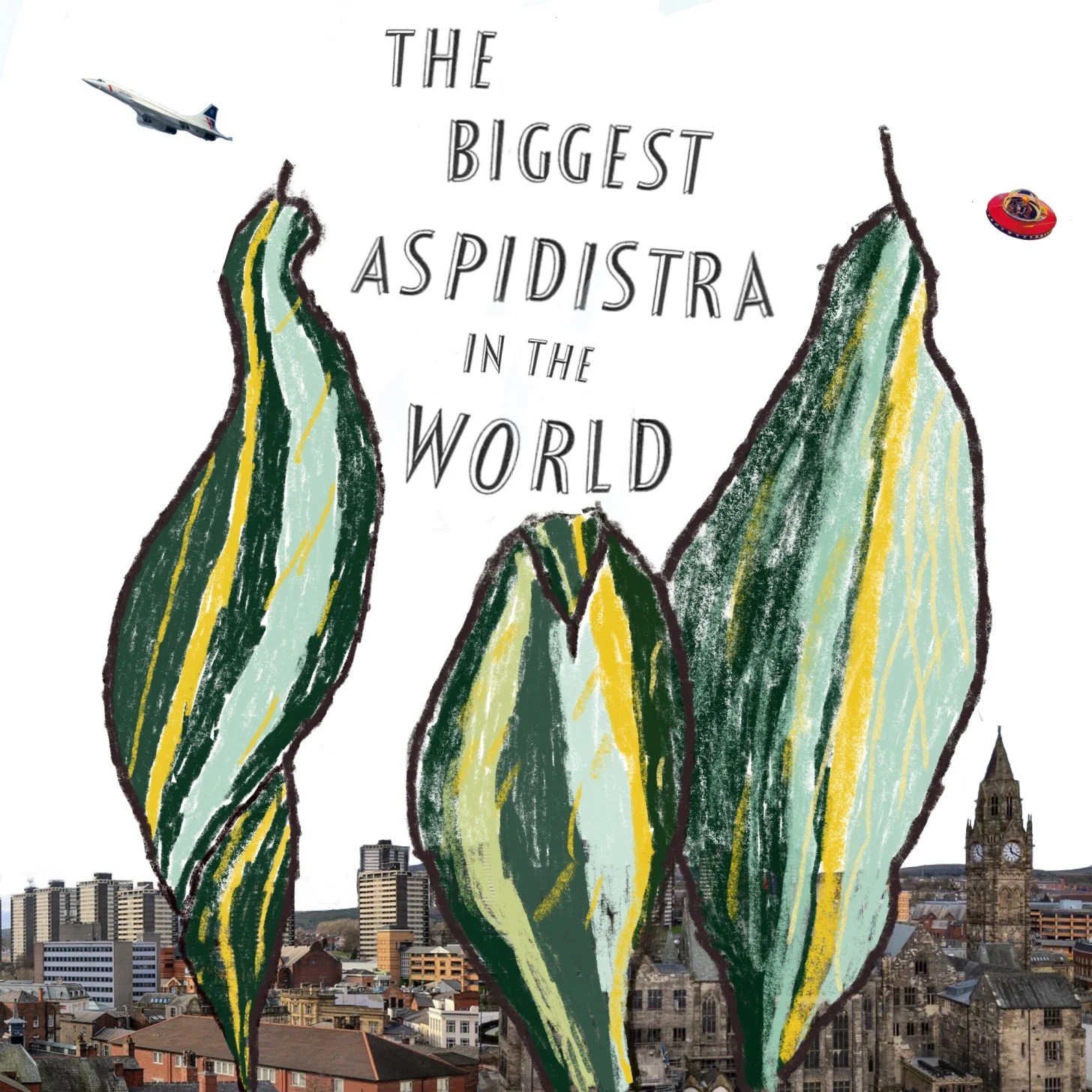
“A barrage balloon,” the Liverpool Echo article goes on to say, “is not the sort of thing you can bring home and hang on the chandelier or put beside the aspidistra,” and on reading that I couldn’t help but think of the Biggest Aspidistra In The World in the song made famous by Gracie Fields, which grows so tall it has to be watered by the local fire brigade, “while its roots stuff up the drains, and grow along the country lanes.” An aspidistra with that kind of girth almost certainly would be able to host a barrage balloon on one of its humongous green leaves without much stress.

It is perhaps crucial to add in trying to bring some closure to this tale, that the article does note that the whole affair happened as the soldier was “returning from a party and whatever might have been his mood of the moment these occasions have been known to inspire elevated aspirations.” And the report goes on to paraphrase the Victorian historian, Thomas Caryle, who once wrote of French statesman going home from scandalous parties and “striking the stars with their sublime heads.” 

Other reports from the time suggest the balloons often prompted a series of light-hearted cartoonish episodes that one imagines Walt Disney could have depicted in Bedknobs and Broomsticks. On Saturday the 16th of March 1940, for example, a headline in The Guardian yells “Men carried up by barrage balloon” and the article goes on to paint a picture of two members of the RAF being carried “over twenty feet into the air by a balloon” in an unnamed north east costal town after the tempestuous thing “got out of hand as it was being launched,” and caused the two men to be carried into the air on the mooring ropes. The rip cord was pulled, and the balloon was brought to the ground, but one can image them floating up into the clouds regardless, their shiny boots striking tottering chimney pots as they advanced higher and higher, off over the North Sea, before being deposited in a field of tulips in Holland.

The stories go on. In Greenwich, during a lightning storm, a barrage balloon dropped onto Woodland Terrace on a house occupied by a Mrs W. B Edwards. “The balloon deflated as it fell and struck the gable of the house bringing down the telephone wires and Mrs Edward’s washing line,” the story reads, while another balloon in Crystal Palace came down on a garden allotment and got caught in some apple trees.

The London Evening Standard of spring 1939, shows a picture of a crowd standing outside J. Salter’s, a dentist at No.178 Kilburn High Road. Everyone is looking upwards, and it must have been a windy day because the people in the photograph are all holding on to their hats.

Another picture shows what they are staring at, a barrage balloon being launched from the top of the Gaumont Cinema, with long multi-coloured shimmery streamers tied to its tail. These beautiful skyborne ornaments were flown above cinemas across Kilburn to advertise the George Formby film “It’s In The Air”, which came out in 1938, and is a gentle farce about a hapless rejected air raid warden who tries to join the RAF just before the war starts.

Those cinema topping balloons must have been quite mesmerizing dancing in the air as grey London geared up for the Blitz. A bit of whimsy to blow the cares and woes away, or as George Formby sings with his Gibson banjolele in the film:

Do I seem a little loony? Well, I am a little loony

For I’ve not been feeling myself all day.

Its… in… the… air … this funny feeling everywhere

That makes me sing without a care today

As I go on my way it’s in the air.

It’s… in… the… air… there’s great excitement here and there

The sun is shining everywhere and spring

Makes everybody sing, it’s in the air!
City Lights

Do certain people leave behind a little of their aura in places that mean a lot to them? I don’t know. I have no idea. But recently, when walking across the grassy Crissy Field, a one-time airfield in San Francisco, on a clear blue day with the Golden Gate Bridge sitting all orangey between the deep blue of the bay and milky blue of the sky, the thought came into my mind that Amelia Earhart had walked there. I could see, in my mind’s eye, an image of her kicking out the chocks from underneath her Lockheed Model 10-E Electra on the very same grass on which I was walking.

Some Googling later in the day proved my hunch correct. Earhart did indeed fly out Crissy Field in the early 1930s, in the days before she became the first person to fly solo from Hawaii to California, and before the construction of the Golden Gate, twined with the Bay’s propensity to be shrouded in a thick fog, made Oakland Municipal Airport a more attractive alternative launch pad for some dare devil flying.

San Francisco is like that. It’s full of ghosts, be they real of fictional. When you see the undulating ski-slope streets of the city, it’s impossible not to see Steve McQueen speeding over them in his Highland Green 1968 Ford Mustang GT during the car chase at the end of Bullitt. Or Ryan O’ Neil and Barbara Streisand doing the same but on a bicycle in What’s Up Doc, before careering into a jingly-jangly parade in Chinatown and getting trapped in a multicoloured paper mâché dragon. And then you think of Captain Kirk and Spock looking for a humpback whale in The Voyage Home, or Jimmy Stewart and Kim Novak looking for each other in Vertigo, or Amelia Earhart standing by her plane on Crissy Field.

Such were the visions I was having as I wandered San Francisco and they were exacerbated by the fact that the city appeared, to me at least, to be a bit of a ghost town itself. Parts of the central business district, a one-time home to countless tech companies, are still to spring back into life after the pandemic, while in the down-at-heel Tenderloin district which borders it, homelessness, fentanyl addiction and petty crime make for a worrying hallmark.

The hotel workers union, during my visit, were on strike, with bored employees sat outside empty lobbies banging on upturned paint tins, the noise echoing through the empty streets like the soundtrack to impending action in some dystopian sci-fi film. I should say at this point that I was in the city at Thanksgiving, which may have been a reason for its emptiness. In fact, one union had laid on a thanksgiving dinner on a sidewalk near Union Square for its striking workers and had set a long table with a white cloth with fifty or more folding chairs pulled to it. The expectant table made for quite an edifying scene, belying the fact, if just for the morning, that this was a city with some problems.

On my first afternoon, still spaced out form the jet lag, I climbed up the steep Telegraph Hill to Coit Tower, a monument to the be-shrubbed mind of Lillie Hitchcock Coit and immortalised by the writer and founder of San Francisco’s City Lights book shop, Laurence Ferlinghetti, in his poem Dog.

The dog trots freely in the street

and sees reality

and the things he sees

are bigger than himself

and the things he sees

are his reality

And he goes past the Romeo Ravioli Factory

and past Coit’s Tower

and past Congressman Doyle

He’s afraid of Coit’s Tower

but he’s not afraid of Congressman Doyle

I was slightly perplexed by Coit Tower, if a little afraid. It seemed slightly ominous sticking up out of Telegraph Hill like an Art-Deco ivory finger. It was even more eery because nobody seemed to be around, except for electric cars, empty electric cars, which would seemingly float down the street towards the Pacific every now and again.

These were the famous driverless cars belonging to Waymo, an even more futuristic version of Uber, which are being trialled in the city. After some hesitation, both of the political and cowardly kind, I decided to try a ride and found it, after the initial thrill of watching the wheel spin autonomously on sharp corners, to be quite an empty experience. It seemed to me to be just another removal of a simple human interaction from everyday life, like the disappearance of the person working the checkout in a supermarket, they’ve all been beamed up to be with Kirk, Spock and the humpback whales, only to be replaced with silence.

In contrast, on one sun-streaked afternoon later in my trip, when I had walked the length of Golden Gate Park to the ocean, legs exhausted, I opted for an Uber over a Waymo and was quickly rewarded with a gas-bagging alternative. The driver, an elderly man, seemed new in town and asked me if I knew where I was going and could offer up a better route than the sat-nav. Naturally, despite being clueless, I was charmed by this request and the thought that I might be so easily assimilated into a place 12,000 miles away from home as to be taken for a local after just two days.

I apologised and said I’d only been around for a few hours, which prompted a long conversation about roots. He was from Hawaii and he seemed to think that given I had come so far, from London to the edge of the Pacific, not going on to see the islands was a bit of a dunderheaded choice.

Did I know, he asked, that it was the Royal Navy’s Captain Cook that discovered Hawaii and that he had named them the Sandwich Islands after the Earl famed for putting cooked meat between pieces of bread? I did not, I said. Did I know, he added, that the union flag still makes up part of Hawaii’s state flag? I did not know that either. Now, this was the kind of high-quality conversation that I couldn’t get from a Waymo, which only seemed to get vocal to scream at me when I didn’t have my seat belt on.

No, the Hawaiian didn’t care about seatbelts, he was more interested in debating the make-up of the English breakfast, and reminiscing about the time he saw Harvey Milk and Dianne Feinstein talking on the steps of San Francisco City Hall. He said he knew then that they would both go far. She went on to become the longest serving female senator in US history. He got shot in the head. Oh, America!

With the likes of Waymo coming to a city near you, one can only imagine that the notion of having a freewheeling conversation with a taxi driver is heading to the same place as Feinstein and Milk: a museum. But I suppose error could still set the technology back a bit. Just the sight of pedestrians waving manically when they walk out in front of the moving vehicles at crossings suggested that the public’s faith is not yet high in the new technology. To begin with I thought they were waving at me, then I realised they were waving manically to ensure that the car’s internal gizmos clocked them and didn’t mow them down.

And what’s to stop these cars going all dystopian, sealing the doors, locking you in and taking off at full pelt over the humps and bumps of San Francisco. Before you know it you’d be racing off into the Pacific and not stopping until you got to the Sandwich Islands to spend the rest of your life eating BLTs.

See, I let my imagination run riot there, while I still can, before I’m replaced by something that can write much more levelled prose than I can, more normal prose, and hopefully, something much more readable.

On the Bus

It is interesting, or perhaps it is not interesting, depending on your point of view, how random and unexpected themes can suddenly appear in our day-to-day lives, take root, flower, and die, all within the space of say, 48 hours. All you have to be is bored enough to spot them.

I would like to give you an example. When recently presented with a free day in New York, I decided to try the only mode of public transport that I have not diced with in the city before: the local bus.

Just like all European roads supposedly lead to Rome, all bus routes in New York appear to lead to the Port Authority Bus Terminal, a grey box that sits opposite the HQ of some local rag called the New York Times. To say it is dilapidated, decrepit, and most of all confusing, (the terminal, not the newspaper, although the description could be easily applied to both) would be a considerable understatement. Dimly lit corridors with flashing yellowing fluorescent lights lead to stuck escalators, petrol fumes poison lost pigeons, elderly people disappear down dingy rubbish-strewn stairwells never to be seen again, all while the engine sounds of moving buses echo around, yet remain frustratingly out of sight.

After a struggle I got the bus to New Jersey, chosen because I would need an inter-state ticket, which sounded romantic, but only required a 30-minute trip. The bus was dirty, but the seats were comfy and felt like an overused sofa in your grandma’s house. Opposite me sat a man in brown loafers reading a thick Sunday broadsheet newspaper, which he opened wide and rustled into the aisle with the page corners so close they almost tickled my elbow, an image I thought had left us along with Ronald Reagan and the walkie-talkie.

Hoboken was my chosen destination because it sounded remote and had birthed one of entertainment’s men of the twentieth century – Frank Sinatra. If you are interested, there is a small statue of him on the waterfront leaning jauntily on a lamppost. Old ladies seem to loiter opposite it and try to pick up guys.

It was this vision of Sinatra twined with the bus ride fresh in my memory that really got the bus-theme up and running in my mind. Wasn’t there a rejected Sinatra album cover of him standing in front of a Greyhound bus, wearing a 60-style blue cardigan, white-t-shirt and gold medallion? You know, when he was trying to look cool for the hippie flowerchildren of 1968? And then, as I walked the lonely streets of Sunday-morning Hoboken, more dead celebrity bus-related factoids started to rain into my mind like asteroids from the Planet Stupid. Didn’t Ernest Borgnine (Ernie Borgnine, the guy with the Cheshire Cat grin who won an Oscar for playing a butcher in Marty), didn’t he get divorced and start driving around the US in a bus he called the SunBum? And didn’t they make a documentary about it called Ernie Borgnine on The Bus? Isn’t it on YouTube? Shouldn’t I re-watch it? And so it went on.

Anyways, a couple of days passed by, during which, regrettably, I had less time to think about such things, before the bus theme returned again. This time I was in my hotel room, I could see the top of the Empire State Building illuminated in the distance, and the television was on the blink. The channels were disappearing into a fog of static that seemed to have come from the same place as the guy on the bus with that broadsheet newspaper. Retro-town.

One of the only channels I could get was TCM. Fine by me. I love old movies. And what were they showing? Frank Capra’s It Happened One Night, with Claudette Colbert and Clark Gable – the ultimate bus movie. The gold standard. And it was just at the bit, that life-affirming wonderful bit, when everyone on that seemingly endless bus ride from Florida to New York, which makes the centre of the movie, start to sing:

The Man on The Flying Trapeze.

Whoa! He’d fly through the air with the greatest of ease

A daring young man on the flying trapeze

His movements were graceful, all girls he could please

And my love he’s stolen away.

Somewhere amid the verses an initially resistant Claudette gives in to the charms of Gable and they fall in love. Just like Steve Martin and John Candy fall in love in their own kind of way, during their own interminable journey across America in the hopes of making it home in time for Thanksgiving dinner in Planes, Trains and Automobiles. Why did that come into my mind? Because there’s a bus scene of course! Somewhere in the middle of the movie, Neal (Steve) and Del (John) go on a bus journey to St. Louis, and isn’t there a sing-song? Yes! Martin tries to lead the passengers in a rarefied version of Three Coins in a Fountain, but it falls flat, prompting everyman Candy to jump into a rambunctious version of The Flintstones theme.

Surely the singing on the bus scene in Planes, Trains and Automobiles was influenced by the singing on the bus scene in It Happened One Night? Surely? I have no idea. If you know the answer, send it to me on a postcard by ways of Stupid-ville, London. I’m really desperate to know.

So, after all these somewhat strange occurrences, on the flight back, when flicking through all the films I didn’t want to watch on the seatback television, what should I spot but a new documentary all about the life of Frank Capra, and it was full of talking heads, naturally talking about how wonderful the bus-singing scene was.

I looked from side-to-side and wondered if it was worth trying to get a sing-a-along going with my fellow passengers. The Wheels on the Bus perhaps? The Bus Driver’s Prayer? How about a song about Rosa Parks? Or Blakey and Stan Butler? Fearing I might get shot, I decided to stay quiet and ride the sky-bus all the way home with Claudette Colbert and Clark Gable.

A Scottish Diary

Day One 

I am on the train from London Kings Cross to Edinburgh Waverley. York Minister is glistening in the early morning sunlight as the train powers up the spine of England, and I start this diary. To begin with I thought the cathedral was Durham. I was getting my cathedrals confused and my geography jumbled.

———

Looking from the train window, I come to the conclusion that there are now more wind farms in the English countryside than churches, which suggests that we are putting our faith into something different.

———

The spires of Darlington pass by – I never knew there were so many spires in Darlington – I count at least three and they are all still stained black with pollution, like the spires of cathedrals in Germany. Later Durham cathedral passes by looking like a huge stone man o’ war in full sail hovering over the town. I’m charting my journey by spotting spires and cathedrals.

———

At Newcastle children with inflatable pillows around their necks run for the train. As we move on the city glistens through the window and the Tyne is wide and gushing. Aside from the cities and the cathedrals and towns, there doesn’t seem to be any discernible change between the countryside of the south and the north of England. Everytime I look down from the train we seem to be passing over a canopy of trees with a river beneath it.

———

A woman reaches into a tree and cuts away at the branches, while her dog gads about behind her in the long grass of a fallow field. Suddenly, the stone of the houses seems darker. The green of the trees is greener. The clouds in the sky are darker. The grass in the fields is wilder and tinged with purple. Is the purple in the fields foxgloves or heather? Foxgloves for now and heather later. All this can only mean one thing – I’m in Scotland.

———

The sky is dark grey all of a sudden and the clouds strangely low for this time in the day, as we get our first glimpse of the sea. It always seems something to see the sea for the first time on a trip, even if in England it really is nothing, given it does not take too long for the sea to appear wherever you travel.

———

At Waverley station workers brandishing long poles are batting down multi-coloured balloons that have become lodged in the station roof. It’s raining and I walk to St Giles Cathedral, which I find to be  small, splendid, homely and warm. It is an approachable building – such is the aim of the Scottish church in general – yet it is crammed with tourists. The tiny Thistle Chapel – the home of the Order of the Thistle – in particular is filled with tourists, phones held aloft – it’s not even that old in comparison with other things in the city. I wonder if any of them know what it is actually for?

———

In Saint Andrew’s Square sits a man high up on a column – strangely not Nelson or Wellington for once, but Henry Dundas – a man whom the Scots are no longer proud due to his attempts to sustain the slave trade, as a new plaque will soon make clear. Such is the obvious disdain on the soon to be plaque, that I’m surprised that the Scots have not taken matters into their own hands, tearing it down like the people of Bristol did to a statue of Edward Colston a few years ago. I suppose one of the benefits of having your statue placed on a column is that you are immune from the changing tastes of the people down below you. Barring some kind of daredevil act, removal is, I assume, all but impossible short of blowing the whole thing up, like the IRA did to Wellington’s Column in Dublin during the Troubles. All this goes to show – never trust a man on a column.

———

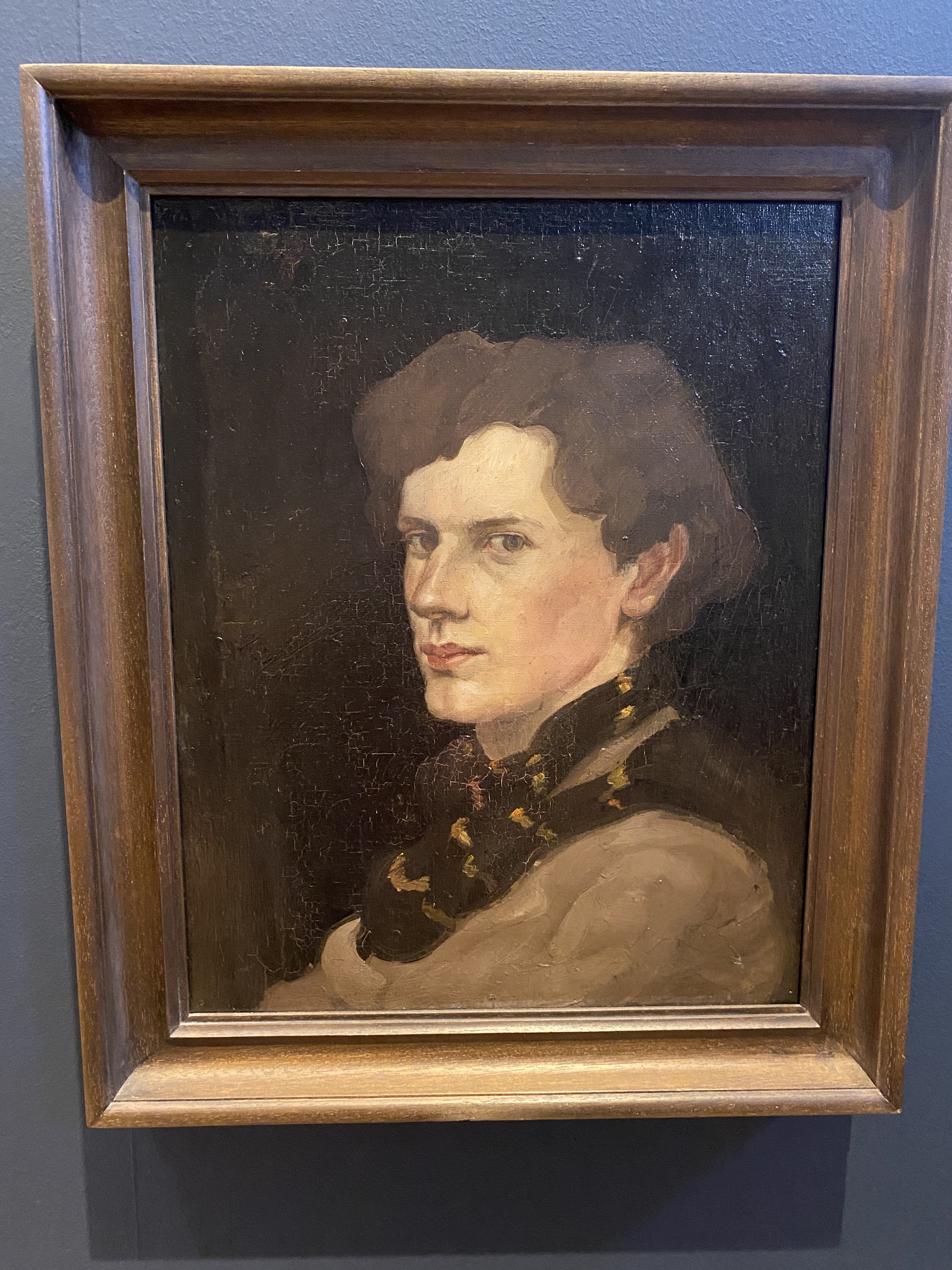
The Scottish National Portrait Gallery is a refreshingly low-key affair when compared with its newly refurbished sister in London. Political and military portraits are thankfully few – even Charles III is relegated to a back wall in another sign of Scotland’s growing desire for its independence. Instead portraits of Scotland’s civilian citizenry dominate. Artists, some of whom I was not aware, play a key part, with self portraits such as one by Modernist artist William McCance standing out.

Day Two

The rain sheets down and I’ve got sunglasses in my pocket – the story of my life in a two second vinaigrette. The train from Edinburgh to Glasgow is a fast one, it seems to barely touch the rails as the misty countryside flies by in a green and purply haze. A woman with a scar on her arm walks up the aisle, while opposite me a young man sits with big white headphones and a ripe banana on the table in front of him, as the train pulls in at Lenzie, before departing for Bishopsbriggs. The mist is very low – it’s in the trees. I’m going to Wemyss Bay – where I will need to find a boat to sail to Bute.

———

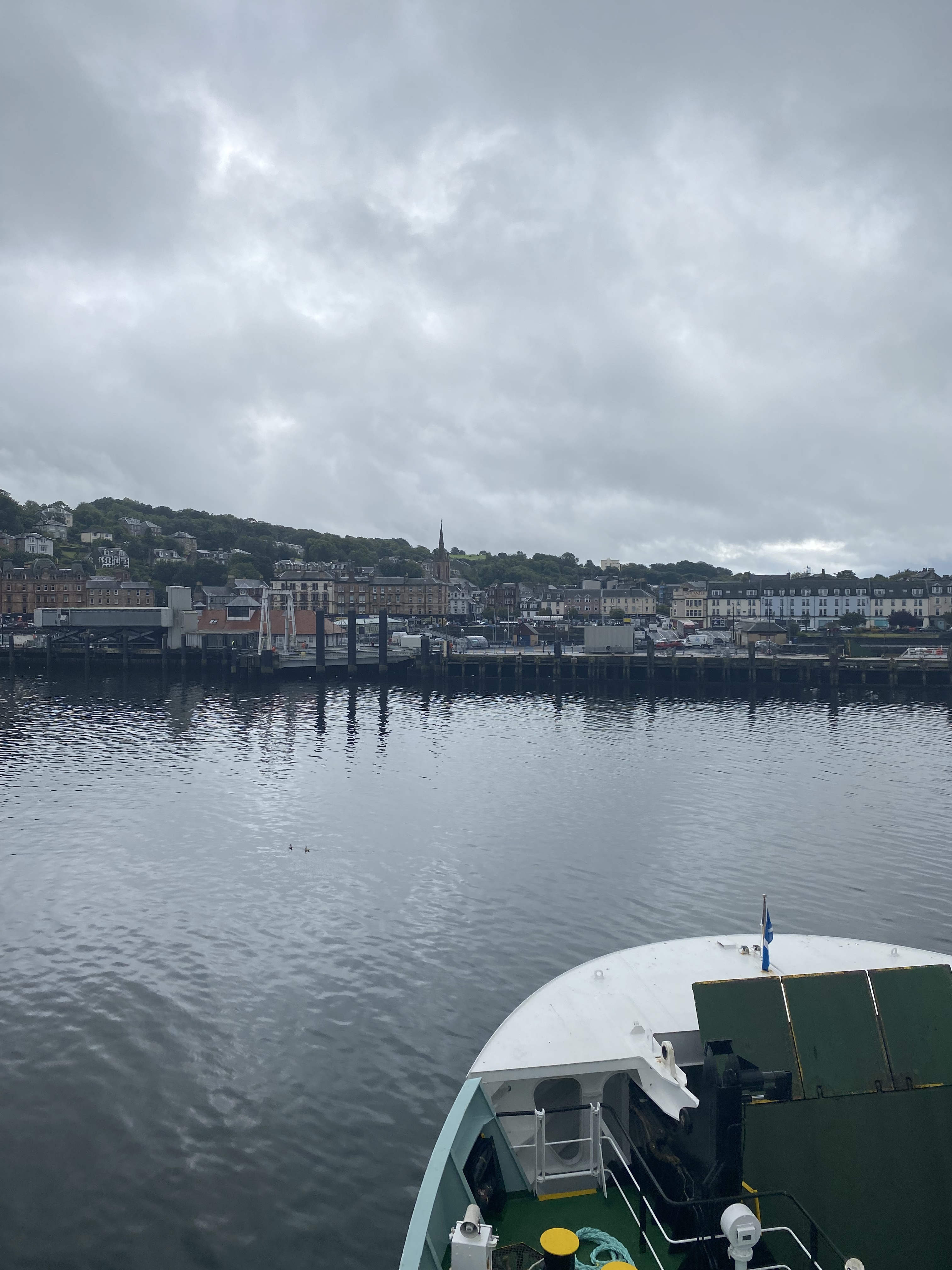
The Clyde can seemingly have seven types of weather at once. In the distance, over the hills, black storm clouds, over us – dingy grey, light wind and drizzle and behind us the odd sunburst over the mainland. Rothesay – the largest town on Bute – appears typically constructed of grey stone as we sail closer, but behind the town there are the peaks of three tree covered hills, which, when caught in a sunburst could almost be in some South American jungle, such is their luscious green and dark dense-looking nature. As I step onto the shore, I realise that the sail and the sea air has cleared the headache that has been troubling me all day.

———

Rothesay is like an old faded Victorian seaside town and it is filled with junk shops. In one shop a man walks in and asks if anyone is good at identifying fish. He gets no answer. So naturally, he walks over to me brandishing his phone, and asks if I know fish, which I most certainly do not. He ignores this and shows me a picture on his phone on an auction website of what appears to be a large taxidermined cod or trout or something attached to a varnished wooden board. So I tell him it’s a cod, or a salmon and the man scoffs that it certainly is not a salmon. So, he asks an elderly woman standing next to me the same question and she also identifies it as a salmon, but she adds the caveat that ‘she does not know fish,’ which he seems to respect more that when I told him the same thing. With this he loses all hope and leaves. As I walk away, I see him in the street again, and he shouts over to me, “well I’m buying it no matter what it is,” before running off into the distance.

———

This is one of those towns where a bus arrives once every hour if you’re lucky – miss it and your plans are severely dented. Somebody asked me if I was lost – sadly I wasn’t. I felt guilty that I did not need the help that was so readily offered.

———

I don’t often travel alone, but the ease at which I’m keeping this diary suggest that I am missing real conversation. In fact, I need to stop writing and look up, otherwise I might miss the bus and then there goes the next hour. I’m waiting for the 1450 to Mount Stewart, I’m writing it down, not just for the record, but so that I don’t forget.

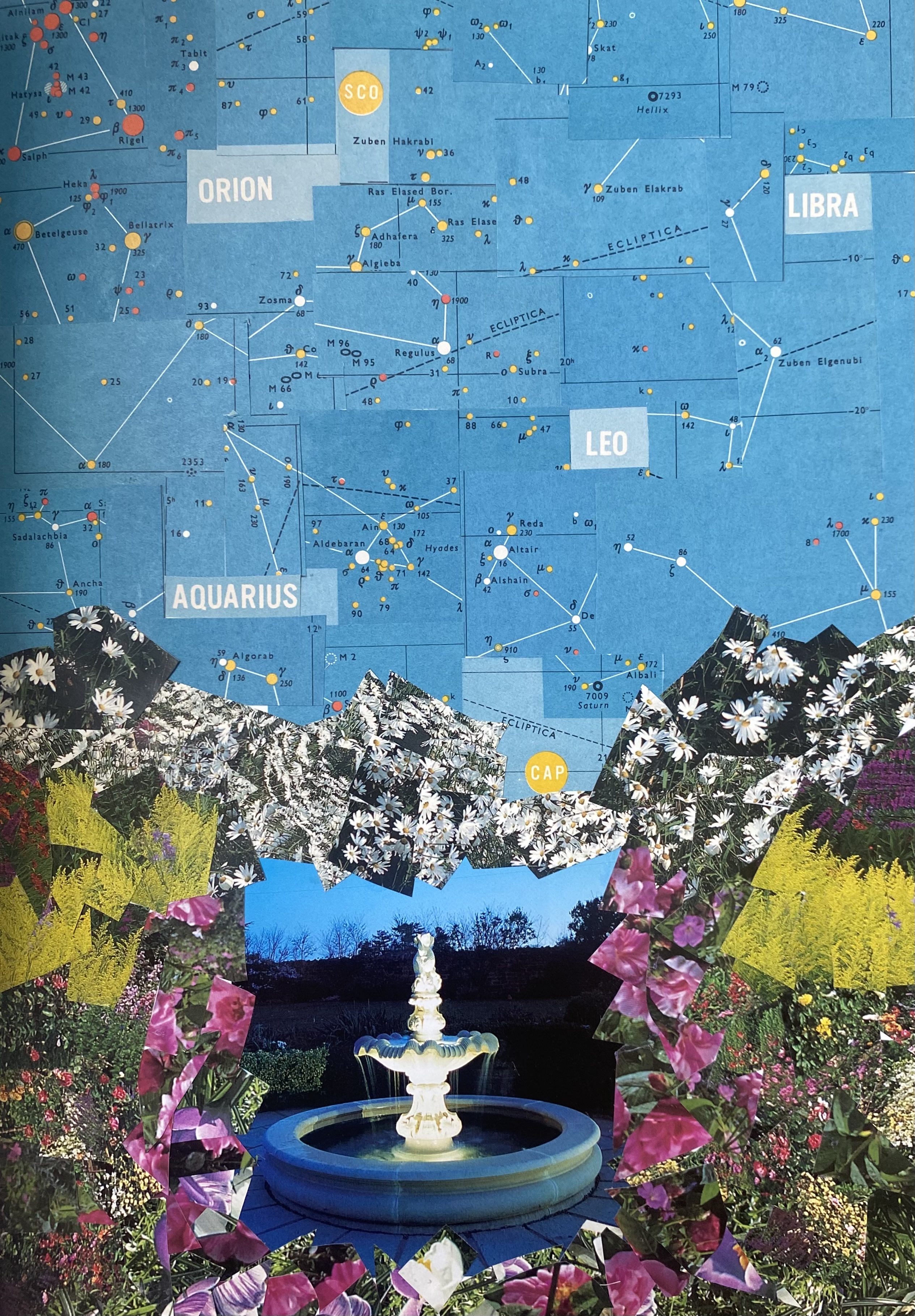
Mount Stewart is such an extra ordinary confection of a stately home – neo-gothic in style, but infused with a dose of astrology. It is extraordinary that the Marquis of Bute has an exact replica of the make up of the astrological night sky on the day he was born painted on his ceiling. During the First World War the house was requisitioned and turned into a hospital and the Marquis’ bedroom became an operating theatre, meaning the injured soldiers could stare up into the night sky while in surgery, and check if they were due any luck before they disappeared into a haze. 

In the dining room the guide -a young girl – literally dared me to ask her a question so I mumbled something about how old the dishes were on the lavishly set dining table. I can’t remember how old she said they were, but I do remember her saying that they put all the chipped ones at the back of the table so people can’t see them. She said that she thought that was nice, because the chips showed that the dishes had been used and were not just for show. I suppose the same goes for people – the more chipped the better.

———

Day Three 

The central gardens of Edinburgh are quite relaxing and run through the very centre of the city like a green vein. The sun has come out finally and I see a man spread out on the grass with a tiny bottle of champagne meant for one in front of him and a crystal glass all set out on a metal the tray. Glamour is not dead in his head at least.

———

This is one of the longer rail journeys I’ve done in my life (it ends up being six hours with delays back to London) and typically I have lost my headphones. So I space reading Wuthering Heights with staring out of the window.  The long railway track to London is lined with people saying goodbye and hello – little individual station-side scenes of happiness and sadness that are perceived from the train like photographs hanging from a country-length washing line.

———

So, what conclusions can I draw, as the beautiful sails of Durham Cathedral appear once more on the horizon, as I make my way back to London and the sun starts to set

I set out wanting to examine the virtues (or lack of ) of traveling alone. Today, traveling alone has lost some of its stigma. It used to be seen by some as the preserve of strange people and the chronically shy. In days gone by some people would rather not travel than travel alone. Today though, traveling alone is seen as a big gleaming badge of honour. It is seen as a way to prove ones independence or to temper any over-reliance one may have on a partner who may – for a multitude of reasons – not always be there. Travelling alone is viewed as a way of ‘getting a little me time’, of finding your inner self, or of smashing comfort zones.

Travelling alone boosts confidence certainly, but it is not always an easy journey, especially if you don’t like your own company.

There is a view – and it is a view I partly subscribe to – that things are only fun if you do them with another person. Experiences are meant to be shared so you can talk about them and remember them together, albeit sometimes from different perspectives. Holding joint memories – be they happy or sad – affords both people a lifelong connection through reminiscence, when it comes.

I do think that it is important to have ‘me time’ and I do think that it is wise to be on at least speaking terms with your inner self and to – crucially – be comfortable with solitude, because no matter how much of a people person you are, you never know when you might suddenly find yourself alone. Loneliness finds its way to everyone in the end, so it is best to be prepared so it does not catch you unawares and in a way that you might find difficult to deal with.

I think over the last few days this diary has for me become a vector for my lack of a companion on this trip – that and finding myself talking up a storm to myself – as everyone who spends some time alone finds themselves doing. I’m sure that the random observations that I would have ordinarily bored the person next to me with I have instead scribbled down on these pages, and because I can be something of a talker, I have found myself with a full notebook.

So I have replaced sturdy shared memories, which can be almost as absolute as celluloid when confirmed with another person, with written words. Is that just as good? Probably not. A few days travelling alone can be good for the soul, I have no doubt, but ultimately we all need somebody to talk to. And if you don’t talk very much at all then just a little bit will do, and you can save the rest to write down.

Fountain fever in Barnsbury

Sometimes, if you look down into the mirky waters of a fountain you will see a carpet of coins. People throw them in and make a wish. So far, not a single coin has been thrown into a new fountain that has been installed in Thornhill Gardens in Barnsbury, London – and I’ve got time on my hands, so I’ve been checking.

I’ve been wondering if I should be the first – and if I am the first – will being so lend my wish any more credence with the wish-answering gods? To be honest, I’ve been wondering if people still throw coins into fountains at all anymore. I’ve been wondering if all the fountains of England are running dry of wishes and if this is one of the forgotten repercussions of our cashless society. Should there be studies done? Is this yet another example of technology inducing in people a kind of spiritual and emotional malaise? Maybe I’m over thinking? Like I said, I’ve got time on my hands.

London is always changing they say, but to me, great swathes of the city seem to stay exactly the same. This can be said of my own slice of London – Barnsbury – which sits sandwiched between Upper Street in Islington and the Caledonian Road. 

In Barnsbury, squares of regal Georgian three-tiered houses are protected by listings and council bureaucracy, which act to keep everything just so. Every now and again though something new does punch through and recently the people of Barnsbury have been entranced by the installation of their new fountain.

The fountain itself is naturally traditional in style and is a nod to the past, inspired by maps from the 1800s which showed a fountain installed in the exact same spot where the new one now sits. Somewhere amid the great sweep of time since the 1800s the original Barnsbury fountain was lost. Nobody knows what happened to it. I like to think it decided to move to a more fashionable part of town so uprooted itself and walked to Hampstead.

The great fountain restoration of 2023 was organised and funded by residents who are not short of a few quid to throw at intrepid – possibly eccentric – local projects.

In preparation for describing the fountain – and because I have time on my hands –  I did take a few moments to Google the term in an attempt to find out the names for the individual composite parts that make one up. I thought that there would perhaps be some romantically Georgian-sounding names that had fallen out of use.

Sadly, I was disappointed. It seems that the base of a fountain – the little man-made lake on the bottom – is simply known as the basin, which was to be expected and in our case is circular and made of reconstituted stone. Above this, on a pedestal, sit two tiers, two smaller bowls that are topped by a spout from which water cascades down into the basin forming small translucent bubbles on the surface of the water that float around like green marbles before popping at the edges.

The garden in which the new fountain sits is serene. It is ringed by trees that have seen two centuries or more and houses that have seen at least three. In the Second World War, there was apparently an air raid shelter here, although its exact location in the garden appears to have fallen from local collective memory and photographic evidence is scant. 

In the 1980s, things took a grizzly turn when on a cold winter’s morning the frozen severed head of a local gangster rolled out of the public toilets that used to sit in the corner of the gardens. The toilet block is long gone, but the cut in the little wall that would have constituted the entrance is still there and I can’t help but imagine the creases of the police officers’ blue woollen trousers brushing against the same stones as they paced around for warmth that morning, drank their flasks of tea, smoked their cigarettes and waited for the grizzled detective in a grey raincoat from Scotland Yard to put a name to the chopped-up loaf lolling by the urinals at the back of the gents. Spolier alert: it belonged to Billy Moseley and the rest of him was later fished out of the Thames.

The days of such drama seem long gone. Today, the fountain’s delicate tinkle creates the audible backdrop in the daytime mainly to dogwalkers and council workers looking for a place for a quick smoke. A recent half an hour I spent sat there saw a whole host of people come and go.

A woman in a bright 60s print dress and sunglasses walking alone with her fluffy white Pekingese approached the fountain and told her dog, “we’ll go around it once and then we’ll go home.”

Later, another woman, coughing, wandered up to the fountain with a friend. To begin with they were talking about horoscopes. “It’s the transit of Venus, it was messing with us all,” one of them said to the other, who didn’t reply directly and instead asked “is that meant to be a lily pad”, as she stared down into the basin. “Well, it’s an asset to Islington,” the other woman mumbled, and I was left to wonder if the asset was the fountain, Venus, or the lily pad.

Opposite the basin, a new bench has been installed. A memorial bench for Claire and Eric Ash, 1928- 2022, local residents who ‘loved to sit here’ or so the bench reads. ‘We live in those little specs of light you see floating through sunbeams’, the engraving goes on to read and while I’m sat opposite, two council workers, a man and a woman, in luminous green coveralls, make the sunbeams bench home for a few minutes. To begin with they sit apart, like colleagues. And then – after turning away – I look back again and he has sidled up to sit right by her side and she’s got her hand on his knee and he’s telling her stories.

Amid that scene a man arrives, takes his top off and lies on a wall near the fountain to sunbathe. Later, a man with greying hair, in a tracksuit, walks in with what he later reveals is a Rhodesian Ridgeback that he bought from a woman in Highbury Fields. The Ridgeback kept running up to the topless man and barking at him. “You’ve got suncream on haven’t you,” the tracksuited man asks the other. “She loves suncream and she loves to talk, but I’m glad she’s like that.”

And so, in a seemingly never-ending stream, people come to the fountain with their dogs and their phones, and their books, and they sit and pass a few minutes. They meet friends, talk to strangers, or talk to nobody at all and then they leave. The new fountain is a meeting place, just as the old fountain must have been in 1896. And a meeting place, then as now, is a place where stories start.

Uncovering a lost family story from the First World War

British troops in the trenches during the First Battle of Cambrai in 1917

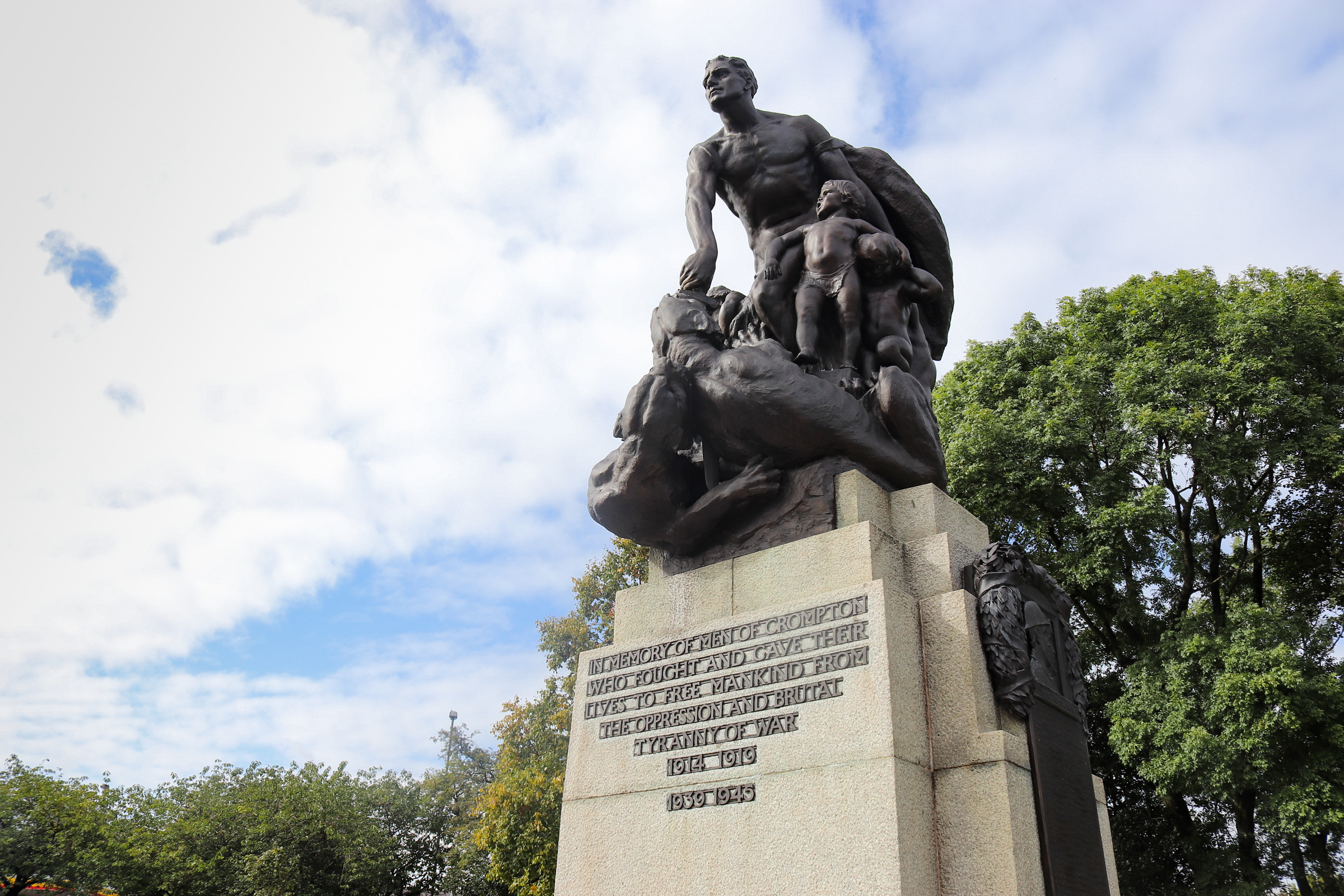
The stories behind the names on the cenotaph in Shaw and Crompton, a small mill town in the North of England, may have slipped from living memory, but they can still be traced in surprising detail.

I have long been aware that a great, great uncle of mine, John William Barrass, is listed on the cenotaph and I remember my grandma taking me to look at his name when I was small.

My grandparents, the only link I had to John William’s story, have gone now, and I recently started some research to see if there was anything I could find out about him.

John, like many millions of young men, would have left for France and the rain sodden trenches of the Western Front full of a spirit of adventure, and Shaw, which was then a northern cotton spinning mill town at its zenith, would have sent boys to war like it sent out countless bales of yarn from its fifty cotton mills.

I knew the name of his regiment and not much more. John had spent his last years in Shaw, but he was born a Yorkshireman and joined up with the King’s Own Yorkshire Infantry in 1914.

I also knew the day of his death, the 11th of December 1916, twenty three months and nineteen days before the peace of Armistice Day.

Armed with these two facts, I started my research at the National Archives where I found the official war diary of John’s regiment.

War diaries were kept by an officer and record the regiment’s day to day activities. When the King’s Own were in barracks the diary is neatly typed in blue ink, but when they were in the trenches, on active duty, the pages are crumpled and muddy, the words scrawled out in a faint pencil.

I found the entry for the 11th of December 1916 to be in a neatly typed blue. The regiment were training in northern France on the day John died.

J.W.Barrass’ name on the Shaw and Crompton war memorial

I guessed from this that John William had died by accident, in a crash perhaps or from a stray bullet fired by mistake.

I assumed that the trail would then go cold, but some persistent Googling led me to the painstakingly researched website of Pierre Vandervelden, a Frenchman who has documented and photographed a great number of Commonwealth cemeteries in France.

Pierre, it turned out, had visited John’s grave in Cambrai, a town in Hauts-de-France, around 60 miles from the Somme and close to the cathedral of Amiens.

In December 1916, war-torn Cambrai had been in German hands and it was likely, Pierre told me, that John had died in the Parmentier Field Hospital as a prisoner of war.

My next port of call was the Red Cross, which has digitised its prisoner of war records and sure enough there was an entry for John.

He had been captured on the 18th of November and was taken to Parmentier with a gunshot wound to the leg.

I turned back to the King’s Own war diary and found an entry for the 18th written this time in a shaky pencil:

“At 5:15am the battalion was drawn up on an advanced line. The conditions were bad, it started snowing just before the attack and observation was very difficult. At 6:10am our barrage was intense and apparently very effective, consequently the enemy sent up a number of flares. This, with the white ground, lit up all the surroundings.

The war memorial in Shaw and Crompton

The line advanced with Munich Trench as their first objective. The left half of the battalion was able to push forward and reach this first objective, but the right half was held up by intense machine gun fire.”

Somewhere, amid this freezing scene was John, aged just 22 and a long way from home.

Again, I assumed his trail would go cold, but an email to the Local History Office in Oldham returned a cutting from the Weekly Chronicle on John’s capture, which quotes from a letter he sent to his wife, Sarah, back in Shaw.

“I have been wounded and am a prisoner of war but getting along alright” he writes. “My left leg just below the knee has been amputated, but I am getting along nicely.”

It was his last message to her, coming after he had been reported missing and the newspaper describes the postcard’s arrival as being a ‘shock and at the same time a pleasant surprise”.

 It most have rekindled a sense of hope, but it was dashed when Sarah received the official confirmation, a week later, that John had died from his injuries.

Two years on, on Christmas Eve, at Holy Trinity Church in Shaw, Sarah remarried, to a twenty-two-year-old bobbin carrier from Heyside. If you close your eyes you can almost smell the scent of the candles burning and the holly boughs tied with red ribbons to the end of the church pews.

The person who filled out their marriage certificate, in neat black ink, accidentally wrote ‘spinster’ next to Sarah’s name and had to make a hurried correction, in thick lines, inking ‘widow’ over the top.

It’s hard to imagine what they were all thinking in that church on Christmas Eve – happiness at a new marriage one has to suppose – but it could hardly have been an unalloyed happiness. The bloodshed on the fields of France cast a long shadow for a long time over mill towns like Shaw and Crompton.

That shadow is gone now, but Shaw’s war memorial stands as a reminder not only to those killed, but of the psychological toll that war must have taken on those left behind.

Five minutes with two famous water rats

In London – a city of some nine million people – I’ve always thought that it is strange that you can sometimes find yourself entirely alone in public. I felt this surprise recently while sitting in the central square of Hampstead Garden Suburb in the shadow of St Jude’s Church.

The vast prim and proper lawn of the square was deserted, and as I sat eating a picnic, stuffing my face, I wondered where everyone was. Given it was the hottest day of the year with the temperature edging 40 degrees and the sun not even over the yardarm – I concluded that I was probably the only person stupid enough to be out and about.

It was architectural writer Ian Nairn’s ‘Nairn’s London’ that had brought me on a sunny Monday morning to Hampstead Garden Suburb – which was built from scratch as a model community in the 1920s. Following his guidebook, which offers insightful, often catty, descriptions of some of the city’s best and least know landmarks, provides a wonderful way to explore London.*

Nairn was not that impressed with central square in Hampstead Garden Suburb. He said it suffered from a “central blankness of imagination” and lashed out at the design’s inhumanity because the square doesn’t have a pub and is instead filled with churches and institutes. It is a valid argument – especially on a hot day.

In my mind – in my heat-induced delirious fever dreams dreamed on that roasting central lawn – I was walking with ghosts through Hampstead Garden Suburb that Monday morning. Ghosts of all the famous people who used to live in that once fashionable area of the city. Maybe if I’d stayed around longer I would have spotted Tony Hancock on a park bench reading a script for the next episode of Hancock’s Half Hour of Robert Donat on his way to the studio. Maybe I would have rowed past Eric Coats, rowing across an imaginary boating lake, as By the Sleepy Lagoon played in my mind.

Sadly, these were just the daydreams of someone with an antique sensibility.

As I made my way back down Hoop Lane, I walked past Golders Green Crematorium, a bizarre looking nondenominational building that is based on the Italian architecture of Lombardy. I’m not sure what Nairn made of it – not much I assume – given it doesn’t appear in his guidebook. But I am easily swayed to investigate a graveyard of quality – so I had a quick look around.

I found myself in a little courtyard – as the soft chanting from a Hindu funeral drifted through the hot summer air – the walls of which were lined with monuments honouring the great and the good of British entertainment.

All generations were represented. The newest plaque was for Barbara Windsor and there is a corner dedicated to musical hell raisers, with one for Keith Moon and another for Marc Bolan. There is a jazz section too, I spotted a plaque for Tubby Hayes and another for Ronnie Scott. But the one that caught my eye read ‘This tablet is dedicated by the Grand Order of Water Rats to the Revered Memory of King Rat – Teddy Brown’.

The words immediately piqued my overheated imagination. What was the Grand Order of Water Rats? In my mind, I sketched an image of a fraternity of sophisticated drunkards that rampaged through Soho’s pubs and caffes in the pre-war years and that Teddy Brown was a kind of Oliver Reed or Jeffrey Bernard of his day, tottering his way into a drink-sodden oblivion.

Some swift googling quickly revealed that I was wrong. The Grand Order of Water Rats are a group of entertainers, founded by music hall comedians, that do good works for charity. Every year they elect a ‘King Rat’ from their community and in 1946 the King Rat was an overweight xylophonist called Teddy Brown.

Brown, it turns out, was very famous in the 1930s, largely for his xylophone skills, but also for his girth, which appears in old black and white Pathe films to have been considerable. He was so fat, apparently, that he had to have an especially wide door fitted to his Rolls Royce, and in one Pathe skit he appears to get lodged in an elevator door.

Teddy Brown

Often nicknamed ‘The biggest musician in the world,’ – films of Brown, who was American and spoke like a Chicago gangster, tend to start with the camera panning upwards from his feet past his huge trousers – which could have doubled as an enormous wind sock at an airfield for zeppelins – before he starts tapping away at a jaunty tune on the xylophone backed by tuxedoed men playing double bases and saxophones.

It struck me, as I stood there learning about Teddy Brown and his giant trousers, that there were whole generations of wonderful entertainers like him that had cut a dash across the music hall stages of London, who now, like the stages themselves, were lost to history.

Teddy Brown died half way through his term as King Rat. He had a heart attack in a hotel in Birmingham. This prompted, one assumes, the Grand Order to gather a conclave to elect a successor. The Order plumped for Bud Flanagan, another renowned music hall entertainer of his day.

Flanagan was exceptionally famous in London, and the wider UK, in the first half of the twentieth century as a member of the Crazy Gang – a kind of home grown Marx Brothers. This group of vaudeville comedians appeared in music hall revues and made films, including 1941’s Gasbags, in which the Crazy Gang float into Nazi Germany in a mobile fish and chip shop attached to a giant barrage balloon. Out of the frying pan and into the Fuhrer.

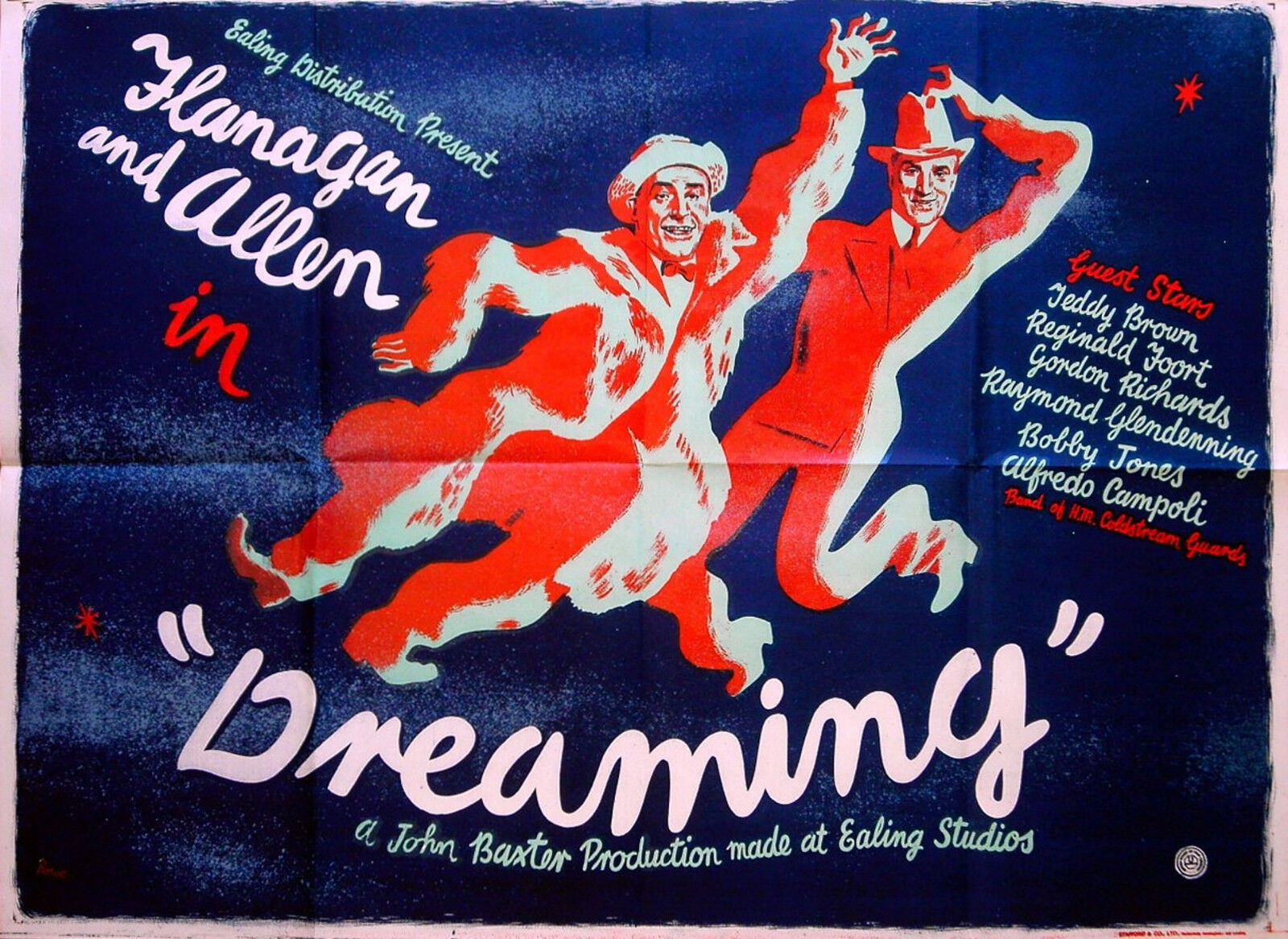
That kind of dreamy scenario was also adopted by Flanagan in his work with Chesney Allen. As Flanigan and Allen – a kind of pre-war Morecambe and Wise – they made Dreaming in 1944, a film about a soldier who dreams a series of odd dreams while out cold on an operating table. They also recorded hugely popular songs such as Underneath the Arches about two down and outs sleeping underneath railway arches who ‘dream their dreams away’ and another song called Strollin’ about a man who knows his “luck is rolling when I’m strolling with the one I love.”

Strangely, or not, given apparent coincidences are often pre-engineered by people with poetic souls, a plaque at Golders Green memorialising Bud Flanagan sits almost directly opposite the memorial for King Rat Teddy Brown. The king and his successor brought together again in one place.

One has to imagine that the vast majority of London’s vaudevillians – a generation or two of wonderful entertainers worth remembering – ended up at Golders Green. That’s a whole lot of lost jokes and songs that are now a whole lot of lost ashes. But never mind, there are still little scraps of evidence of their existence that it’s possible to stumble across on a wander through North London on a summer’s afternoon. Just keep your eyes open and you’ll spot them too.

As an added bonus click here for a playlist featuring some of the songs that inspired this article.

* I would highly recommend Ian Nairn’s ‘Nairn Across Britain’ series in which he travels across the country looking at buildings that were, at the time, under threat. Many of the structures are now sadly lost, but the series is still worth watching all the same – particularly the episode in which Nairn drives from London to Manchester. In fact, I first discovered him in a YouTube video that someone had made of Nairn driving into Manchester as The Duritti Column’s Otis plays in the background.

The Beatles or The Rolling Stones? One answer to a perennial question

I must confess from the outset that for me there has only ever been one winner of the Beatles versus Rolling Stones contest – The Beatles – but every long-held opinion deserves an appraisal from time to time.

Let’s be counterintuitive for a second and start not with the music but with geography.

Naturally, as a Northerner, my love of the Beatles has surely been part fostered by the fact that the group launched their journey to world domination from the Cavern Club in Liverpool, which sits 46 miles away from where I was born in Oldham, Lancashire.

However, it recently occurred to me that by an unlikely quirk of fortune (or misfortune depending on how you look at it) I have come to know, over the past decade, the home of the Rolling Stones – World’s End in London’s Chelsea – much better than I have ever known Liverpool.

The first iteration of the Rolling Stones’ line-up lived at 102 Edith Grove in the early sixties, in a flat Mick Jagger and Keith Richards later described as ‘squalid’ and around the corner from a ‘cheap Italian joint’ – which I think just might still be in existence in the form of Mona Lisa on the King’s Road. The caffe still serves up bowls of remarkably cheap (for Chelsea) amatriciana festooned with long ribbons of English bacon, which should be enough to drive any self-respecting Italian mad.

It might be the only survivor from the days when World’s End was the beating heart of Swinging London. In the early 1960s, as the Lot’s Road power station belched out black soot that poured over the derelict bomb sites that would one day become Westfield Park, Vivienne Westwood arrived from Tintwistle in Derbyshire to set up a shop in World’s End, while local resident Christine Keeler set out on a liaison that would make political history.

I would like to say that it is still possible to feel a ribbon of throbbing cultural energy flying through the World’s End – but sadly it appears to have long since moved on – in fact, anyone innocent to the area’s history today would surely pass through it without giving it a second look.

I felt somewhat the same when I lived in Marylebone in a top floor flat at 14 Devonshire Place. On sunny days when my room would swelter, I would climb out through the bathroom window and sit by the chimney pots. I could see all of central London from there, including at the bottom of my street, the roof of number 57, the house where Paul McCartney lived with Jane Asher in the early 1960s.

McCartney wrote Yesterday in that house. The melody came to him in a dream. Virginia Woolf walked down Devonshire Place and Wimpole Street too. Florence Nightingale set off to the Crimea and into legend from a house on the street behind and Stephen Ward lived in Wimpole Mews during the Profumo affair. And yet, if you walk down the street today, all you will sense is a whiff of anesthetics seeping out of all the expensive dental clinics that now call the street home.

One thing that does strike me as interesting about 102 Edith Grove in Chelsea though, is that there is no exterior evidence that the building played any role whatsoever in the early years of one of the most famous bands in history.

Which is strange given that if you go to practically any location associated with the Beatles, be it Strawberry Fields or Penny Lane in Liverpool, or Abbey Road or 57 Wimpole Street in London, you will find a landmark covered in international graffiti messages and crawling with people taking photographs. Outside 102 Edith Grove there is nothing.

I suppose that is because the Beatles are a spiritual band  and people need something real to hang on to in the fab four’s absence – whereas the Stones are very much still a physical group. In fact, the band played a four hour concert in Lyon in searing temperatures at the start of this week on the latest leg of a convoluted European Tour. The Beatles, on the other hand, exist only in our imaginations, frozen in time forever on a London rooftop on a frigid January lunchtime in 1969 – the last time the group played in public.

If you are going to attempt to form any argument that the Stones outshine the Beatles then the case has to rest on the Rolling Stones’ longevity.

By 1968, the year the flower power dreams of the early 1960s were disintegrating, the Beatles released the brilliant White Album, which is a culmination of all the extraordinary influences that Paul, John, and George soaked up over the previous decade. They would release one more album while still together, Abbey Road in 1969.

The Stones, in 1968, released Beggars Banquet the first of a four album run that would culminate in 1972’s sublime Exile on Main St. It is a musical journey that charts not only the tumult of 1968, but 1969’s Altamont Festival in California –  the blood splattered concert headlined by the Stones that was policed by rampaging Hell’s Angles and which, unsurprisingly, became a vortex of violence that ended with four people dead.

It is the Stones – not the Beatles – that charted the collapse of the 1960s into blood spilling and recriminations, as well as the hedonistic selfishness of the early 1970s. While the Stones were at the very centre of that whirlwind the Beatles were in full retreat mode with Paul McCartney recording his lo-fi solo debut before disappearing to the seclusion of his Scottish farm.

The Stones – as a fully functional touring group –  would go on to age in public, to experience tragedy, to pick up drug and drink addictions by the bucket load, to enter middle age and old age as one collective that has told, over the years, the story of a lifetime, an extraordinary multi-decade story, a multi-century story, while the Beatles are frozen in time.

But. There was always going to be a but.

There is the music to consider. When it comes to the music, for me, the Beatles will always tower over the Rolling Stones.

The Rolling Stones were and remain a brilliant rock and roll band, with a love of the American blues combined with a dash of jazz, which was provided by the wonderfully self-effacing Charlie Watts in his Huntsman suits. By the way, I must say that although I would champion John, Paul and George any day over Mick and Keith, when it comes to Charlie versus Ringo, for me, Charlie wins it hands down.

The sound of the Rolling Stones is a potent, delicious mixture, but the recipe has largely gone unchanged since the early 1960s. It can, if you listen to album after album, start to sound a little painted by numbers, a little similar.

The Beatles, on the other hand, have something the Stones never had, a genius for melody provided largely by Paul McCartney. They were also willing to experiment. You won’t find a musical dream so all encompassing, so downright strange and wacky, so hypnotically brilliant as A Day in the Life on a Stones record. You won’t find anything close.

The legend of the Rolling Stones will live forever, but it will be the Beatles’ songs that people will still be singing a thousand years from now.

All music matters – not reputation

Karen and Richard Carpenter during the Carpenters international tour in 1972

Having a good taste in music is like having a good taste in wine – it takes time, effort and practice to acquire. Sometimes though, people just want to get sloshed and then vintage, vineyard and finesse count for little. It is the same with music, one day we want to appreciate, explore and learn, while the next we want to party, dance, wallow and weep.

Musical snobbery – a crime of which I have been guilty – is just as tiresome as wine snobbery – and ultimately just as useless, because a person needs a rounded appreciation in order to cater for any mood.

Yes it is fun, advantageous even, to develop a good taste in music and it is wonderful to adventure through the esoteric fringes of the musical universe. But, this is not a trip that should be taken for the sake of building street cred or while chasing some impossible definition of that ultimately undefinable word “cool”.

The truth is that some wonderful things are not cool and never will be, but you may still need them in your life. If you define yourself by “cool” alone then you will miss out on so much that is good.

I was thinking about this recently while I read Why Karen Carpenter Matters by Karen Tongson. It caught my eye because it finally confirmed my long-held – often privately long-held – belief that the Carpenters deserve a bit more respect from toffee-nosed music connoisseurs.

Why?

Well, first of all, there are only a handful of bands in music history – and the Carpenters are surely one – that are so distinctive, so immediately recognisable, that you place them as soon as you hear a few seconds of a song.

For some reason, I have always had a kind of strange photographic memory when it comes to the Carpenters. The moments – entirely innocuous – when I have heard a song of theirs in public are seared into my brain and I cannot explain why.

Most recently, last Christmas, I heard a song of theirs playing in a pub in Yorkshire while I was ordering lunch, and I remember sitting in Bermondsey in London, in a tea-total hotel bar, sipping a glass of hot chocolate as Superstar came over the sound system.

Why do I remember these things? I have no idea.

All you need to hear though is the drifting harp at the start of Superstar – which sounds like the start of an underwater scene in an old movie set in a kingdom of mermaids – to know exactly who you are listening to. Then along come those minor oboe chords that lead us to the deep, deep sounding vocal, “long ago, and, oh, so far away, I fell in love with you after the second show…..”

I only recently discovered that the song is a cover of one originally written by Bonnie Bramlett and Leon Russell. It sounds so much like a Carpenters song. It sounds like the pinnacle of Carpentry.  But that is the hallmark of a brilliant artist, someone who can entirely inhabit something that is not their own and then record the definitive version.

I mean, technically, Frank Sinatra was a covers artist, but he often recorded what ultimately would become the most famous version of whichever song he touched, such was his talent.

Karen Carpenter has gone down in history as a tragic figure, a tragic singer of sad songs, when in fact she was an exciting, young, vivacious woman and something of – which the Tongston book highlights -a feminist hero.

Karen Carpenter on stage

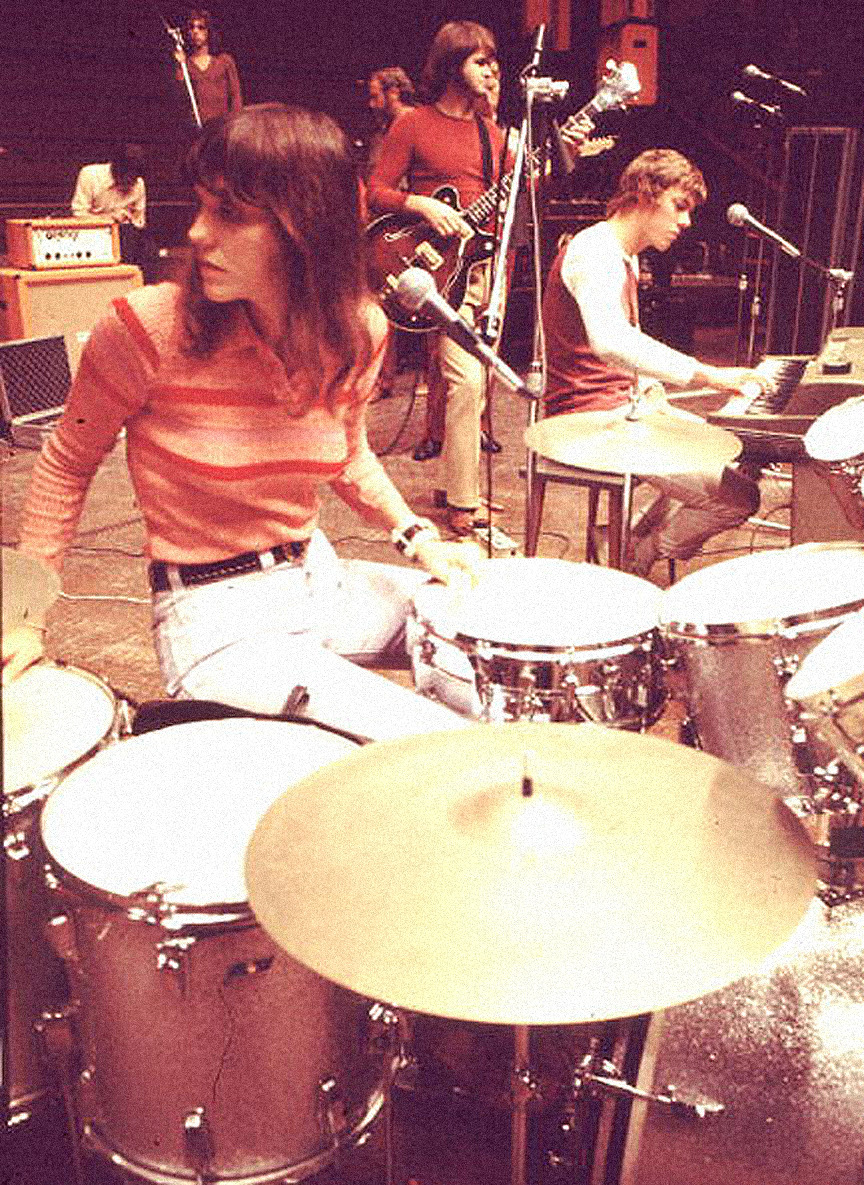
I’ve always thought that she deserved a lot more respect for not only being a singer, but a drummer too, and not only that but a singing drummer all at once, a very rare feat in music and one that few do well, with only Ringo Starr, Levon Helm of The Band and The Velvet Underground’s Moe Tucker coming immediately to mind.

And not only did she just sing and play the drums. She sang and played the drums with a voice that could stop a room, one of the most note perfect voices in music history.

She also – rather marvellously – upended the assumption formed by her supremely talented and dorky older brother – Richard – that he was the musical genius of the family, only to be lapped several times over when his sister’s extraordinary vocal gift became apparent. Ouch.

We can’t kid ourselves though. The Carpenters have baggage. They were safe, unthreatening, apolitical in an era when it was almost impossible to be so, plus they were white, as white as white can be. And, let’s not forget that they played at the Nixon White House in 1973 and were introduced by the president as ‘the best of young America’, which is not exactly the kind of endorsement that does wonders for your image.

Yes, they could be corny, but they produced music with a unique sound, music that makes you feel something, be it good or bad. Music that sounds perfect, yes, but as we all know, came from a struggling central source.

It is perhaps that we know the tragic end of her story that we can feel the same way listening to Karen Carpenter as we do when we hear John Lennon sing (Just Like) Starting Over.

If either Lennon or Karen Carpenter could win the chance to start over, it is doubtful that either one would want to be famous all over again.

Oh, and John Lennon was a Karen Carpenter fan, by the way.

It is rare that my increasingly irrelevant and out of touch musical opinions gain any justification through books published or articles written, but in this case, the Karen Carpenter case, I was right. Karen Carpenter matters.

In fact, I would say that all music matters, no matter what its reputation, from Harry Styles to Wolfgang Amadeus, as long as it makes you feel something.

So what’s next? I’ve always said Al Stewart’s Year of the Cat is one of the best pop songs of the late-1970s. Maybe ever. So, Al Stewart matters?

And what about Rickie Lee Jones? Rickie Lee Jones certainly matters. I mean, have you ever heard Pirates? Now there’s an album to savour….

Concrete Feathers and Porcelain Tacks – The Photographers’ Gallery

There is a lot to say about Rochdale.

Economically it is one of the most deprived areas in the UK, but culturally Rochdale is anything but.

Byron, the legendary romantic poet, owed his title – Baron Byron of Rochdale – to the town. Gracie Fields, one of the most internationally famous actresses and singers of the 20th century was born in Rochdale, and most famously, the town gave birth to the modern Cooperative Movement.

The pioneers who founded it based the Cooperative on the ‘Rochdale Principles’, the most crucial of which states that each cooperative has to be run democratically by its members and that membership should be open to all no matter what race, religion, sex or sexuality a person happens to be.

Rochdale’s community is a patchwork quilt of numerous sections. The town is extraordinarily diverse, and despite well-documented problems over the years, Rochdale’s community has remained largely tightly knit.

While other nearby towns, such as Oldham, saw a fraying and an erupting of racial tensions in the 1990s and early 2000s, Rochdale retained a sense of togetherness – despite its many adversities – to offer a welcoming home to people from all over the world.

For example, at a time when the very existence of Ukraine as an independent nation is being threatened by Russian troops menacing its borders, it is important to note that Rochdale has long been a safe harbour for Ukrainian people in times of strife.

Rochdale was the first town to recognise the Holodomor Famine – a man-made catastrophe caused in part by Joseph Stalin’s decision to single out Ukraine for harsh treatment in order suppress an independence movement – as genocide.

The famine killed as many as ten million Ukrainians and there is a memorial stone commemorating the event in front of Rochdale Town Hall.

It is Rochdale’s community that multimedia artist Helen Cammock pays tribute to in her exhibition ‘Concrete Feathers and Porcelain Tacks’ which is now in its final days at London’s Photographers’ Gallery.

The exhibition, which was put together in cooperation with Rochdale’s wonderful Touchstone Gallery, uses film, photography, text, song and performance to present all the different facets of Rochdale’s bustling community in one place.

Cammock uses the Cooperative Movement and the town’s proud industrial heritage as a starting point and uses this base as a way to examine the power and potential of a social collective.

An immersive, nearly two-hour film, forms the centrepiece of the exhibition and it features people working together to make the town a better place, while outside the projection room objects that are referenced in the film are on display.

A Ukrainian choir is featured singing a traditional song on a bandstand in one of Rochdale’s many parks. In another section Sultan Ali is interviewed, a man who went from growing up as a shepherd boy in Sahiwal in Pakistan to becoming Rochdale’s first Asian Muslim mayor in 2003.

Rochdale resident Pete is also featured, a retired joiner, who speaks of his attempts to re-wild an abandoned patch of scrubland close to the town centre. His success is evident, as he lists the countless numbers of wildflowers, butterflies and birds that he has spotted in the years since he began his work.

A Bangladeshi artist is depicted showing the sewing machine skills – a nod to Rochdale’s textile industry- that were passed down to her by her parents and grandparents. Her knowledge has proved to be an inspiration for her artwork and she is pictured using an antique sewing machine by the side of Hollingworth Lake – a popular local beauty spot.

The conversations depicted between the residents capture discussions about the future and the past, the good and the bad, but most importantly they focus on common experiences.

All stills from Concrete Feathers and Porcelain Tacks, 2021 © Helen Cammock 
Courtesy of the artist

“The spaces we inhabit are different shapes to everyone. The comfort we enjoy is not the same from one community to the next – from one home to the next,” Cammock comments.

“But some strive more for a sense of collective parity. The Rochdale Principles embody this notion of a shared role, responsibility, and stake in what little or great opportunity and subsistence a community generates.”

This is an exhibition that proves that despite Rochdale’s often harsh industrial history and the problems that still confound the town and its community to this day, a sense of humanity, humour and warmth still shines through.